
For years, Linux on the desktop has been described as “the year of Linux”, a promise that never quite arrived. But starting in 2024, something genuinely interesting happened. Linux desktop usage began to noticeably increase, and that momentum has carried through 2025 and into early 2026.
While Linux is still far from overtaking Windows or macOS, the growth itself is meaningful. As of 2026, it is clear that this is not a temporary spike. Let’s look at what’s happening, why it’s happening, and why it actually matters now.
The Numbers: Small but Clearly Growing
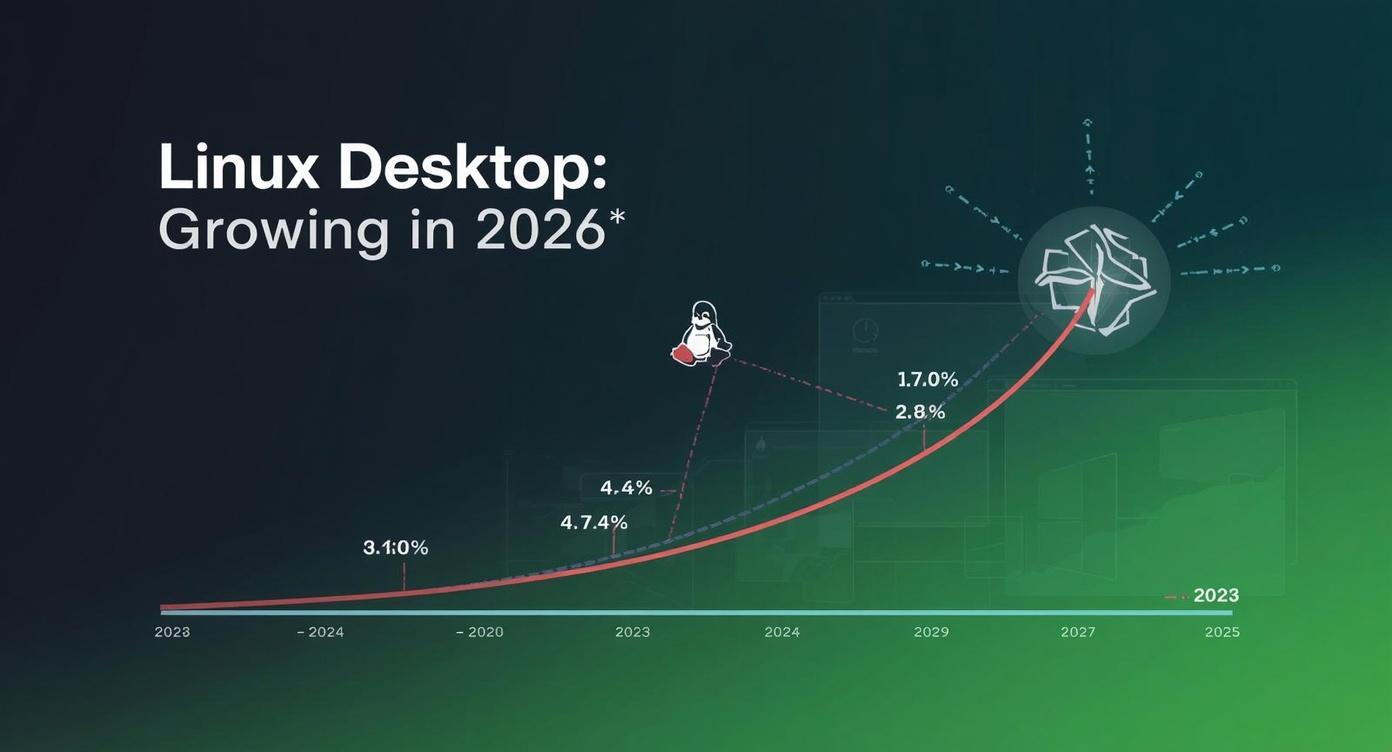
Market-tracking platforms consistently showed Linux desktop usage crossing 4 percent globally in 2024, a level it had never reliably held before. Throughout 2025, Linux continued to gain users, reaching around 5 percent in several regions.
That may sound small, but in a desktop market dominated by two major operating systems, a sustained 1 to 2 percent increase represents millions of users.
More importantly, this growth has continued into 2026, confirming a steady upward trend rather than a short-lived anomaly.
Why Are More People Switching to Linux?
1. Windows 10 End-of-Life Fallout
Microsoft officially ended Windows 10 support in October 2025, forcing many users to make a decision.
A large number of perfectly functional PCs could not meet Windows 11’s hardware requirements, particularly TPM and CPU restrictions. Instead of replacing hardware, many users turned to Linux as a long-term solution.
For many households and businesses in 2026, Linux has become the practical way to keep existing computers usable and secure.
2. Continued Frustration with Windows 11
Windows 11 has remained controversial due to:
- Strict hardware enforcement
- Higher system resource usage
- Deep integration of ads, telemetry, and online accounts
For power users, developers, and privacy-conscious users, Linux continues to feel like a return to control and simplicity.
3. Linux Is Easier Than Ever in 2026
This is a major factor behind the recent growth.
Modern Linux distributions such as Ubuntu, Linux Mint, Fedora, and Pop!_OS now offer:
- Straightforward installers
- Reliable driver support
- Polished desktop environments
- App stores that replace terminal-heavy workflows
By 2026, Linux is no longer an operating system only for experts. It is approachable for everyday users.
4. Developers and Remote Workers Drive Adoption
Developers, DevOps engineers, and remote workers continue to choose Linux because:
- It closely matches server and production environments
- Development tooling is mature and well supported
- Performance remains predictable
- Containers and virtualization work exceptionally well
As remote and hybrid work remain common in 2026, Linux fits naturally into modern workflows.
5. Gaming on Linux Is Now Established
Thanks to Proton, the Steam Deck, and Valve’s ongoing investment, Linux gaming is no longer experimental.
By 2026, many popular Windows games run on Linux with minimal configuration. For gamers who value performance, control, and system transparency, Linux has become a viable daily platform.
Why This Growth Actually Matters
Linux growing from 1 percent to 2 percent was easy to ignore.
Growth from 3 percent to 5 percent and holding into 2026 is different.
At this scale:
- Hardware vendors pay attention
- Software developers test Linux builds more seriously
- Game studios consider Linux compatibility earlier
- OEMs continue experimenting with Linux-preinstalled systems
Linux does not need to dominate the desktop market. It only needs to be large enough to be impossible to ignore, and by 2026, it is reaching that point.
The Future of Linux on the Desktop
Linux is unlikely to replace Windows or macOS entirely, and it does not need to.
Instead, it is becoming:
- A reliable option for extending the life of older hardware
- The default operating system for many developers
- A privacy-respecting platform for power users
- A legitimate choice for gaming and everyday computing
The growth that began in 2024 has proven durable. By 2026, Linux desktop adoption is being driven by real-world necessity, not just enthusiasm.
Final Thoughts
Yes, Linux desktop users have increased since 2024.
Yes, that growth has continued into 2026.
This is not a sudden revolution, but it is something more important.
It is sustained adoption.
Linux is no longer waiting for its year.
It is steadily earning its place, one user at a time.